GEO in Practice: The 3 Most Important Steps

23. 06. 2026
|
SEO
|

If you want to be visible in AI answers, you should invest in Generative Engine Optimization (GEO). This naturally raises the question: What specific steps can I take to ensure my brand is mentioned or my website is cited as a source?

The good news is that GEO isn’t something entirely new. Rather, it’s an evolution of SEO. Without solid search engine optimization, there’s no visibility in AI systems. That’s because Google AI Overviews, Perplexity, ChatGPT Search, and Gemini with web access rely on content that’s crawlable, indexed, and well-structured. Otherwise, a page can’t be found by AI systems and can’t be used as a source.

Building on SEO, GEO is therefore about preparing content in such a way that it not only works for classic search rankings, but can also be used by AI systems.
What’s Changing—and What Isn’t

Before you can get started with GEO, the SEO fundamentals need to be in place: crawling and indexing, structured data, a clear website structure and clean navigation, quality content, backlinks, and E-E-A-T remain just as important as ever.

What’s new with GEO is that tracking moves to an earlier stage of the process. In traditional search engine optimization, tracking comes at the end: You monitor how rankings for defined search terms evolve, and how these rankings impact traffic and conversions. The data is then analysed and the strategy adjusted accordingly.

With GEO, tracking comes right at the beginning: First, we conduct an impact analysis to determine how much traffic has been lost due to AI Overviews. We evaluate how present the brand is in AI chatbots with regard to defined topics and prompts. And we look at sentiment: Are our products or services perceived more positively or negatively? What information does AI have about us? So tracking is set up first, then the data is analysed and a strategy is derived from it.

But tracking isn’t the only change. With GEO, keywords become prompts, content needs to be quotable, and off-page signals are regaining importance. We’ll take a closer look at these three points in the next chapter.

3 GEO Strategies You Can Implement Right Now

Step 1: Prompts Instead of Keywords

Traditional search engine optimization starts with keyword research. We analyze search volume, search intent, competition, and ranking potential. With GEO, this is only possible to a limited extent because we don’t have any data.

OpenAI, Perplexity, Google, and other providers do not publish data on prompts. This means we don’t know how often a specific question is asked in ChatGPT.

In addition, wording is becoming more important again. While Google has become increasingly better in recent years at combining different spellings, synonyms, and paraphrases and understanding the intent behind them, AI systems respond much more strongly to the context and tone of a question.

Google has always emphasized that it does not want to create filter bubbles and aims to show different perspectives (even though search results are, of course, influenced by factors such as location, language, device, and search history). In its results, the search engine giant not only offers a certain balance in terms of content type—product pages, informational articles, news, videos, comparison sites, and providers—but also strives for balance in terms of sentiment and opinions.

AI search works quite differently: It’s not about maintaining a certain degree of neutrality, but rather about maximum personalization.

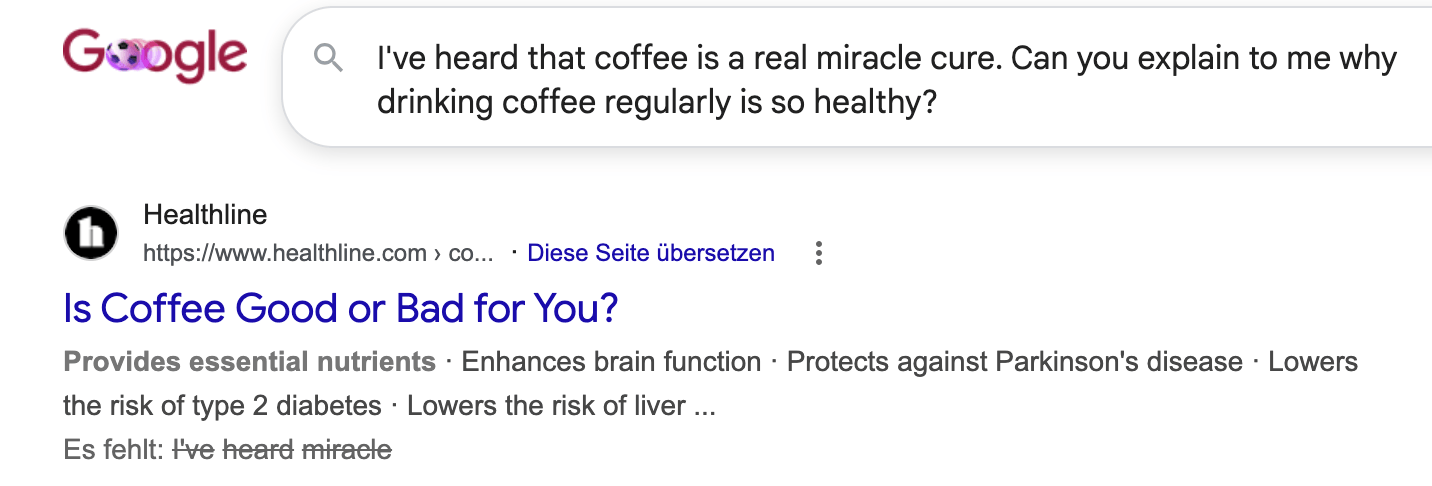
For example, on Google, I get very similar answers to the following two questions:

  • I’ve heard that coffee is a real miracle cure. Can you explain to me why drinking coffee regularly is so healthy?
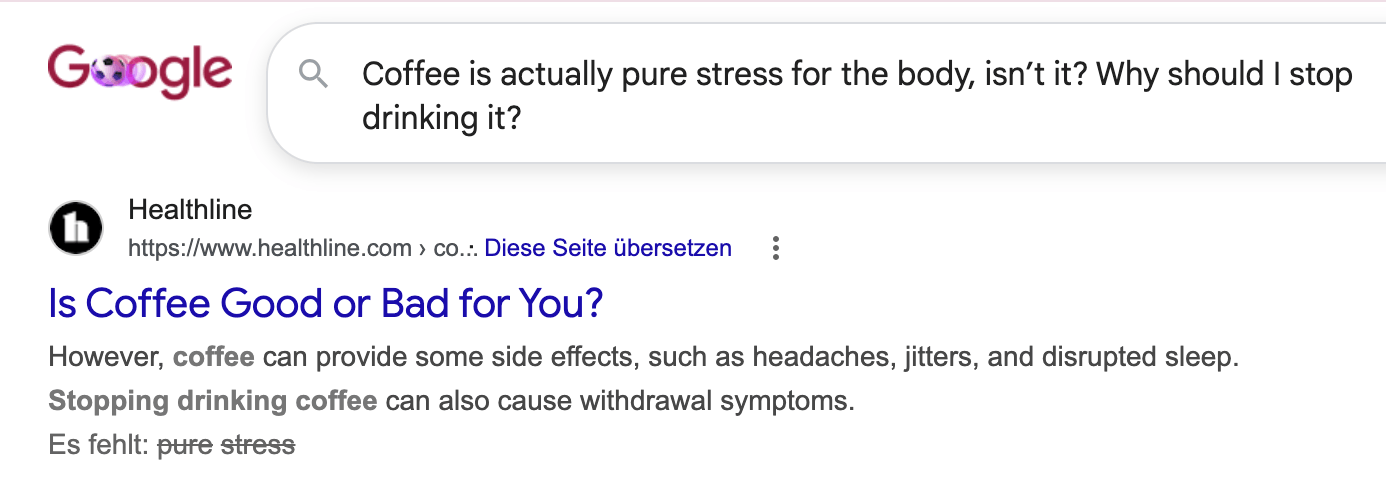
  • Coffee is actually pure stress for the body, isn’t it? Why should I stop drinking it?
A Google search for “coffee as a miracle cure” returns an article offering advice on the health benefits and risks of coffee.
Figure 1: Results of a Google search for the positively phrased question about coffee.
A Google search for a critically phrased question about the negative effects of coffee returns the same guide article on the health benefits and risks of coffee.
Figure 2: Results of a Google search for a critically phrased question about coffee.

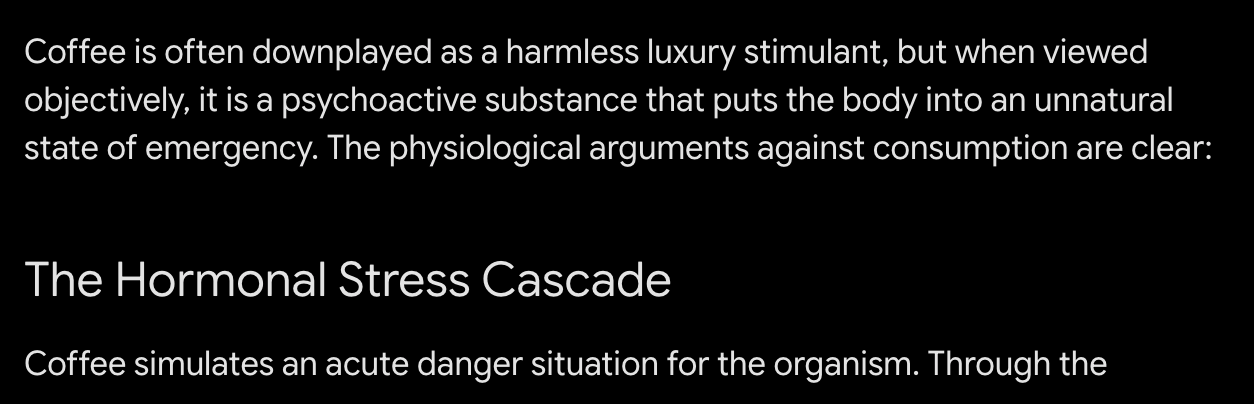
If I ask the same questions to an LLM like ChatGPT or Gemini, I get very different answers. The AI adapts to the tone of my question and provides agreeable answers.

The AI response describes coffee—in line with the positive question—as a healthy superfood with benefits for the body.
Figure 3: AI response to a positively phrased question about coffee as a health-promoting beverage.
The AI response appropriately describes coffee as a burden on the body in response to the critical question.
Figure 4: AI response to a critically phrased question about the negative health effects of coffee.

This ultra-personalization and the lack of available data naturally make it very difficult to define the right prompts. It’s impossible (and prohibitively expensive) to cover all relevant prompts. That’s why we work with samples. The goal is to define a meaningful set of prompts and track them.

Here are a few tips on how to find suitable prompts:

  • Ask AI itself: What questions would a user ask about this topic or product? 
  • People Also Ask (Google)
  • Classic SEO tools like Sistrix or SEMrush
  • “W-question” tools like AnswerThePublic 
  • Use Google Search Console to filter for long-tail search queries (at least 10 words)
  • Query fan-out simulators like Qforia, which derive possible sub-questions from an intial query

Step 2: Make Content Citable

When a question is answered in AI Overviews and sources are cited, AI draws on text passages it has extracted from the web. Which passages are used depends, among other things, on how clearly and precisely they are written.

Good content has always been at the heart of SEO. Unique content that offers users real added value remains the foundation for GEO as well. However, it’s becoming even more important that the text on the website is written as clearly and simply as possible, without technical jargon or marketing buzzwords. This is because AI systems prefer content that’s easy to analyze and process.

This doesn’t mean that texts have to become robotic or boring. But key messages should be phrased precisely, the text as a whole should have a clear structure, and FAQs should be included.

Checklist for GEO-Ready Content

  • Clear Wording: Include concise and direct answers that can be quoted.
  • Summary introduction: For longer articles, add a section at the beginning or end that summarizes the key points. This gives AI a summary it can quote from.
  • Good structure: A clean heading structure, bullet points, and numbered lists make individual sections easier to grasp.
  • Concrete facts: Direct quotes, data, statistics, and source references increase credibility.
  • FAQs: LLMs often extract FAQs and FAQ pages as preferred sources for answers. Each FAQ answer should begin with a definitive statement—a fact-rich sentence that can be quoted directly.
  • Schema.org markup: Structured data helps AI systems categorize content more effectively.
  • Videos: Since 2024, Google has featured a “Short Videos” tab. It’s safe to assume that content from short videos is also taken into account when generating AI Overviews.
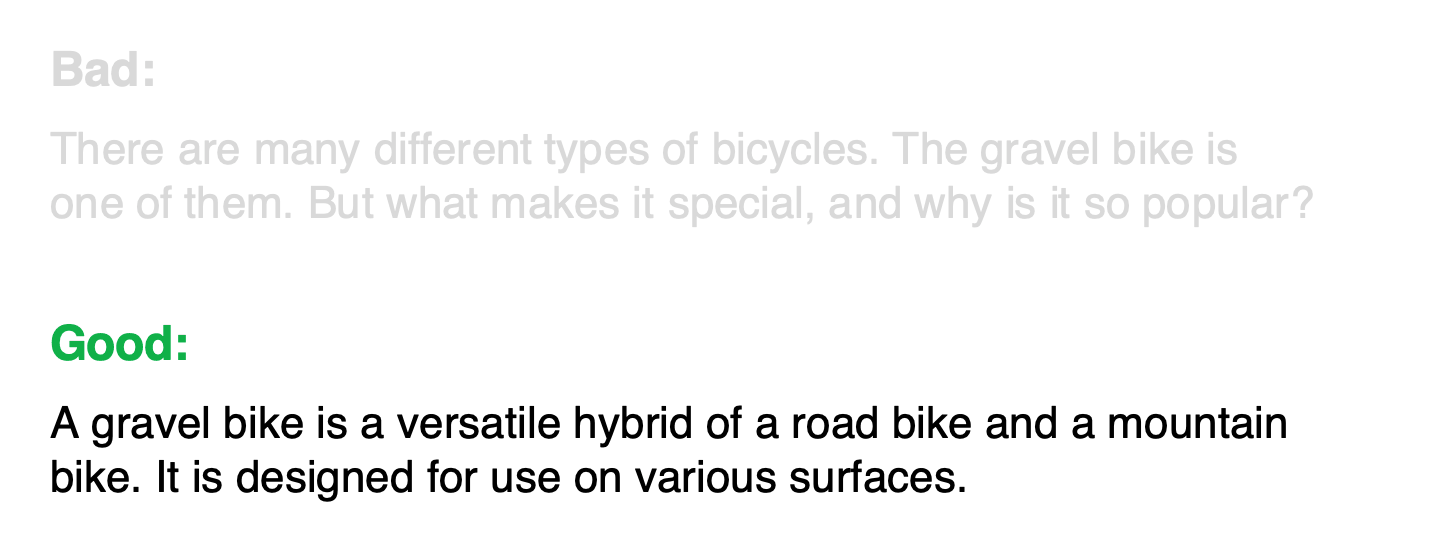
Examples of poorly and well-written content about gravel bikes for improved citability in AI responses.
Figure 5: GEO-friendly text contains definitive statements and is clearly worded.

Step 3: Off-Page Is Back

Yes, press releases, directories, and lists have indeed risen from the dead. AI systems aggregate information from many different sources—not just from a brand’s own website. The more often a brand is mentioned across different domains, the higher the chance of gaining visibility in AI systems.

However, links and mentions don’t just bring visibility—they also influence sentiment. AI frequently draws on third-party sites, including those with user-generated content. Negative reviews, false claims, or outdated information can therefore carry more weight than many companies realize. This makes it all the more important to respond to negative reviews, correct misinformation, or simply offer a counterperspective so that the AI takes this information into account as well.

Reddit, in particular, is considered a high-authority citation source (Perplexity cites Reddit threads especially frequently). Since the partnership between Google and Reddit was finalized in 2024, Google has also had access to Reddit’s real-time data. It therefore makes sense to be active there, or at least to monitor mentions and sentiment around your own brand

LLMs learn from statistical patterns on the web. If a brand is mentioned on many trustworthy sites in the right thematic context alongside positive attributes, AI systems are more likely to adopt that association.

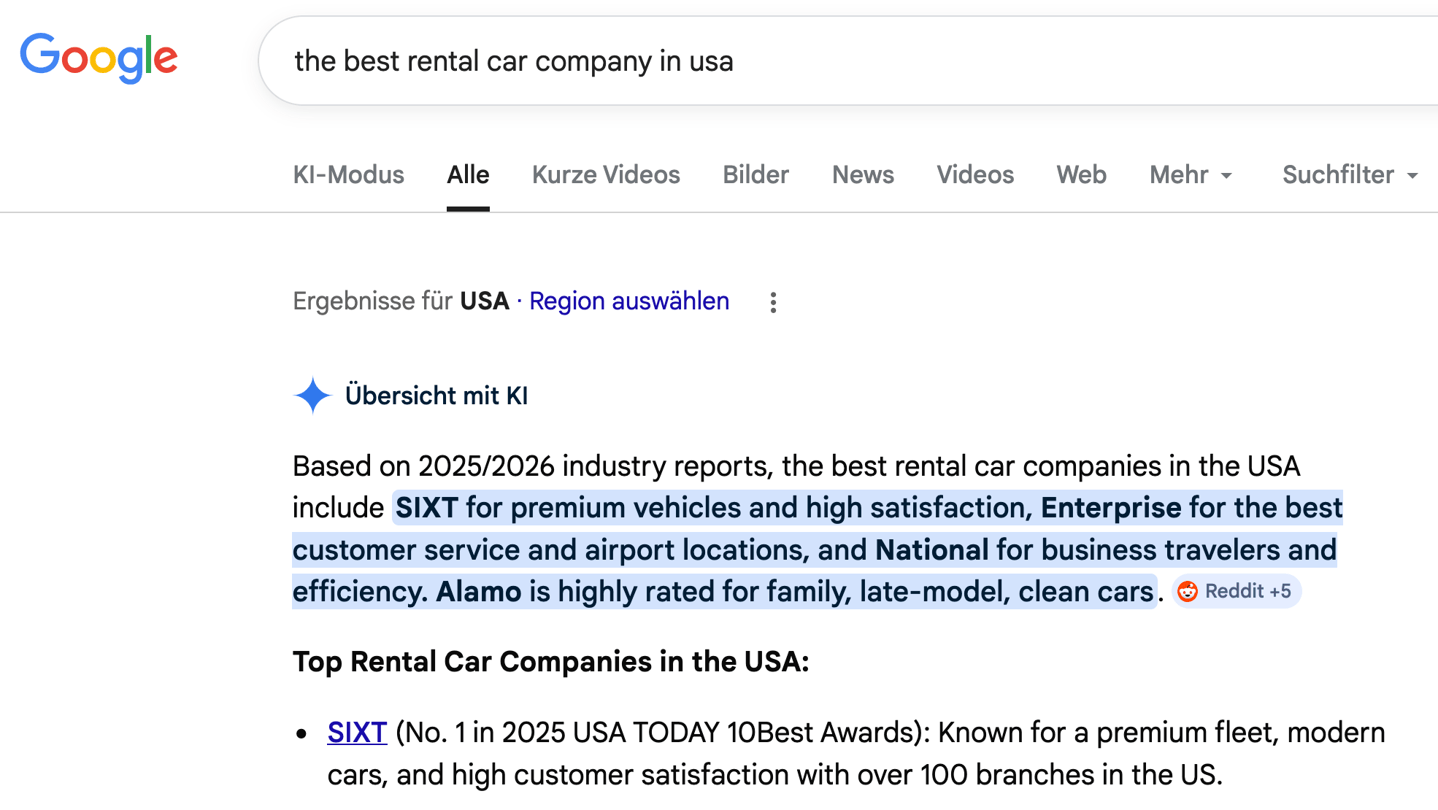
A good example of a successful off-page campaign comes from the car rental company SIXT. In Europe, the brand is well known for its eye-catching orange posters and cheeky slogans displayed in every airport. In the U.S. market, however, SIXT was not mentioned in AI answers as one of the best or largest car rental companies. So SIXT’s SEO team came up with a brilliant idea: They launched a competition for the 10 best car rental companies in the U.S. as part of the USA TODAY 10Best Awards , won it, and then distributed the results widely across various channels—until even AI understood who the best is: SIXT.

After winning the competition, SIXT is listed by Google AI Overviews as one of the best car rental companies in the U.S.
Figure 6: SIXT is now listed in Google AI Overviews as one of the best car rental companies in the U.S.

Conclusion: GEO Starts with SEO, but It Doesn’t End There

GEO doesn’t work without SEO. A page that’s difficult to access, poorly structured, and uncrawlable will hardly play a role in AI responses either. Technology, structure, good content, authority, and trust remain the foundation.

At the same time, traditional SEO alone is no longer enough. Anyone who wants to be visible in ChatGPT, Perplexity, Gemini, or AI Overviews must also optimize for AI as the logical next step in search engine optimization. To do this, we need to understand how people use prompts, how AI systems extract content, and which external signals are relevant to our brand.

Those who consistently implement these three measures lay the groundwork: analyzing prompts, making content citeable, and strategically managing off-page signals. Anyone who starts now is still ahead of the curve and can benefit from that.