AI Overviews Are Revolutionizing the Customer Journey: Can SEO Keep Up?

10. 07. 2025
|
AI
-
SEO
|

AI Overviews and large language models now answer search queries directly on the search results page. As a result, the way people search, and the way websites get discovered, is fundamentally changing. Or, in extreme cases, they are no longer being discovered at all.

In this article, I take a closer look at how LLMs in general – and AI Overviews in particular – are reshaping search behavior. What does this mean for website owners? And how do we need to rethink SEO?

But before exploring what is changing, let’s take a step back. What used to work best in SEO? What was the most effective strategy for driving traffic and conversions to a website?

How Informational Searches Drove Organic Growth

In traditional SEO, search queries are generally divided into three categories: navigational, transactional, and informational.

  • Navigational: Searching for a specific website or brand, e.g., “YouTube.”
  • Transactional: Searching for a product or service with the intent to make a purchase or complete a transaction, e.g., “Brooks men’s running shoes size 43 sale.”
  • Informational: Searching for information at the beginning of the decision-making process, e.g., “How many miles do running shoes last?”

One of the most effective SEO strategies over the past decade was to create as many touchpoints as possible throughout the customer journey and bring users to a website as early as possible. This was primarily achieved through high-quality, helpful content. This content was often in the form of blog articles, and the key was to rank as highly as possible in the search results.

Traditionally, the main focus has been on informational searches. The goal was to generate as many clicks as possible, because clicks were the foundation of everything that followed. Ultimately, the objective was to drive conversions or monetize the traffic in other ways, but it all started with attracting users to the website.

A Proven Strategy

This strategy worked exceptionally well for many years and proved resilient through numerous changes and challenges.

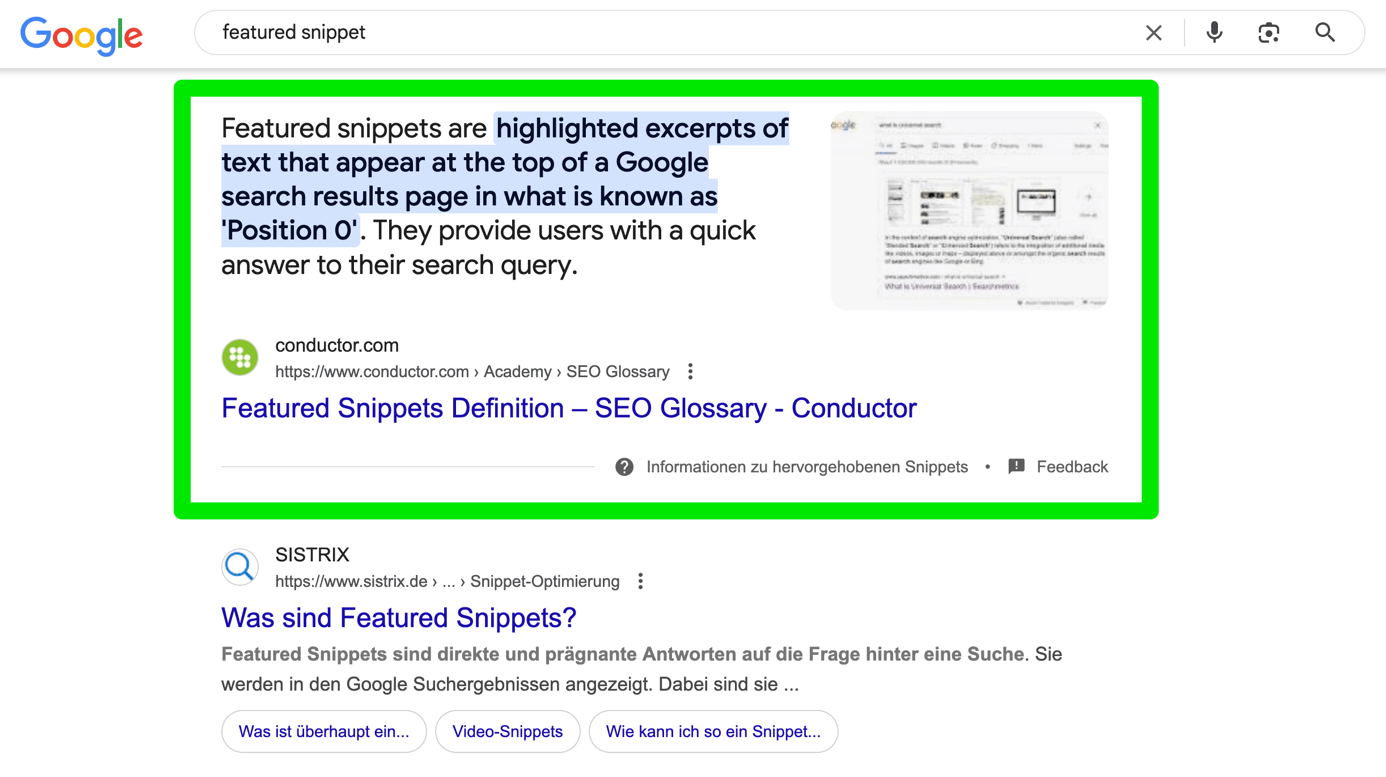
The introduction of Featured Snippets above Google’s organic search results around a decade ago marked the beginning of a new era. Google started answering many search queries directly on the search results page, often without requiring users to visit an external website. Since then, the number of zero-click searches has steadily increased. More and more users are finding the information they need directly on the search engine results page (SERP), without ever clicking through to a website.

As a result, some website owners experienced a decline in traffic, some more than others. Nevertheless, Google remained by far the most important and dominant source of website traffic.

SEO professionals adapted their strategies accordingly. We began optimizing content specifically to appear in Featured Snippets. However, the fundamentals of SEO remained largely unchanged. We continued to approach SEO much as we had five, ten, or even fifteen years earlier: building keyword strategies based on search intent and search volume, creating high-quality content around relevant keywords, ensuring a solid technical foundation, and strengthening domain authority and trust through high-quality backlinks.

The Introduction of AI Overviews

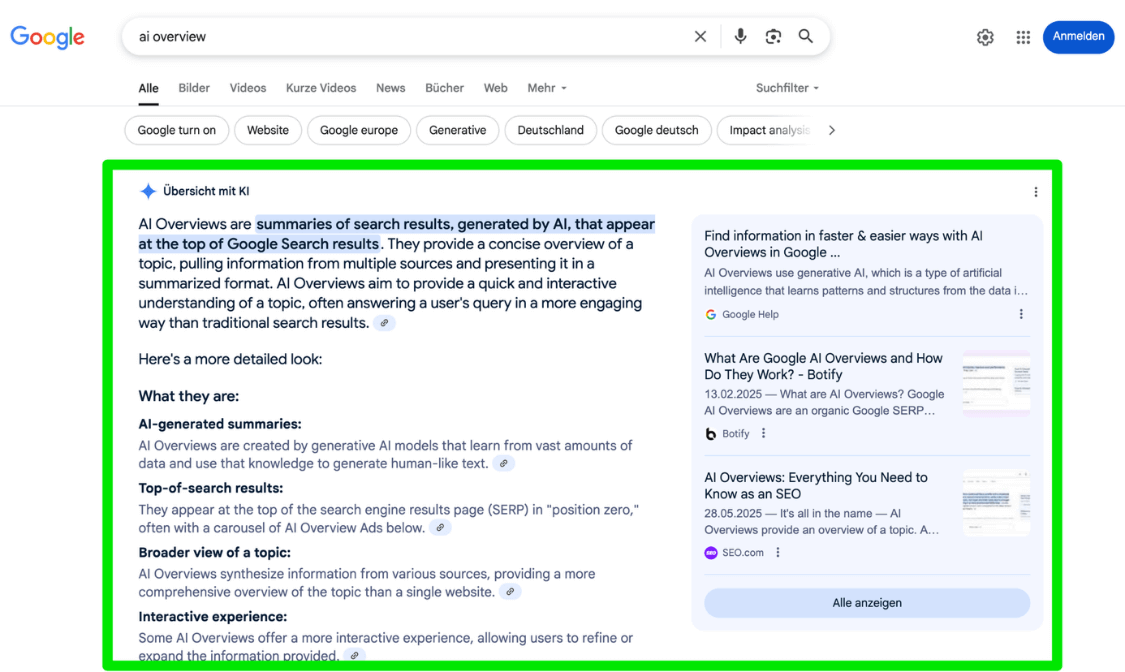
Google introduced AI Overviews in the United States in May 2024, followed by the DACH region in March 2025. They were Google’s response to ChatGPT and other large language models (LLMs), which had begun drawing an increasing number of users away from traditional search. At the same time, AI Overviews represent Google’s attempt to evolve from a traditional search engine into an answer engine. The shift in search behavior, and its impact on organic traffic, was immediate and impossible to ignore.

Google certainly did not hold back when rolling out AI Overviews. It was actually quite the opposite: initially, AI Overviews appeared for a very large number of search queries before Google scaled the feature back. Once enough user data had been collected, the share was increased again.

Large-scale studies currently estimate that AI Overviews appear for around 13% of all search queries. Approximately 80% of these are informational searches.

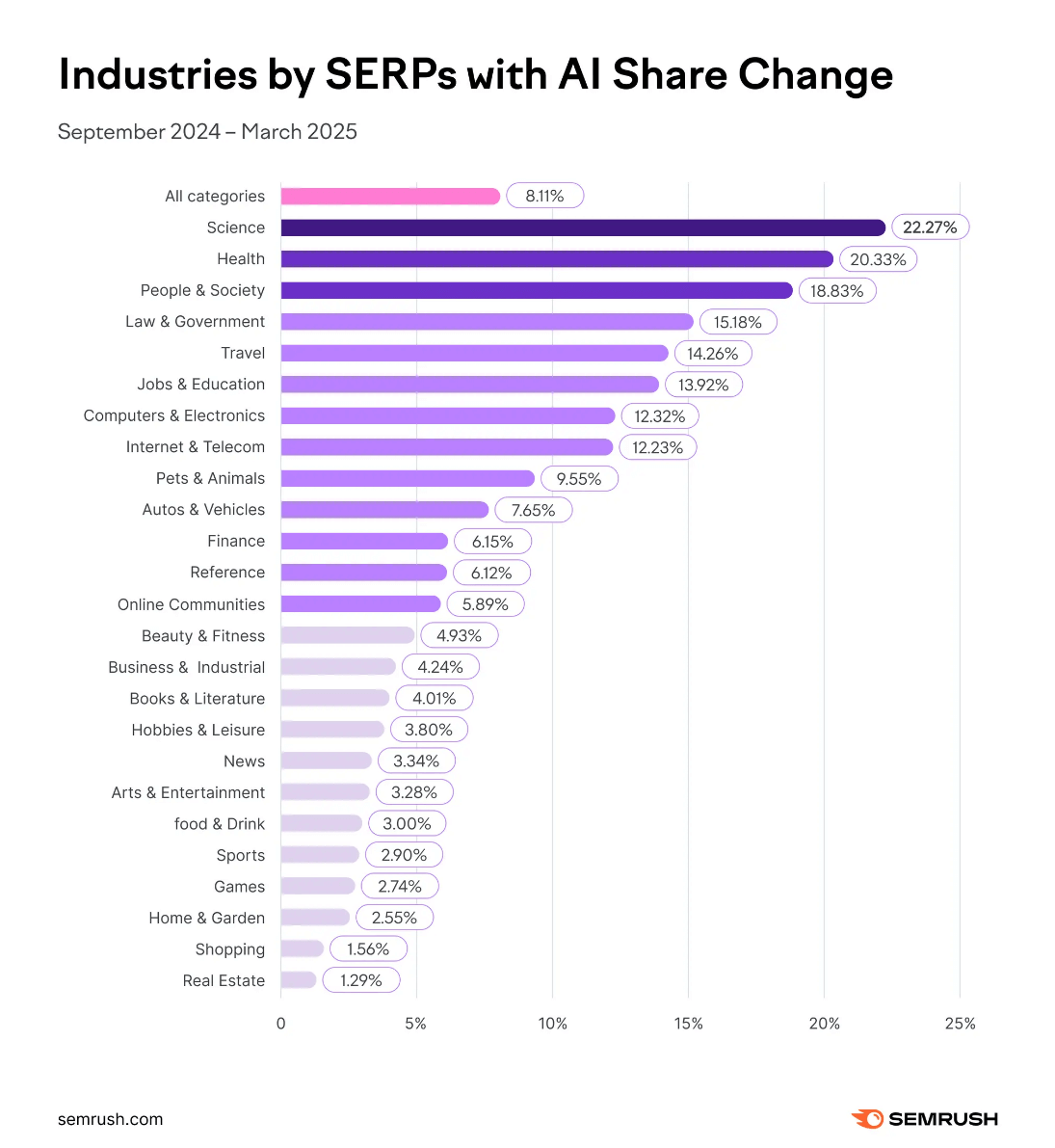
The likelihood of an AI Overview appearing also depends heavily on the industry and varies considerably by topic. Areas such as science, health, law, travel, and education are particularly likely to feature AI Overviews. Categories such as e-commerce and real estate are affected far less frequently.

AI Overviews appear especially often for queries relating to explanations, decision-making, or technical problems. Examples include: “How does … work?”, “Is it dangerous if …?”, or “When is the best time to …?”

Source: SEMRUSH

The numbers clearly show that a large share of Google users is more than satisfied with this new feature. Here are a few reasons why I believe AI Overviews have been so well received:

  • Instant gratification: AI Overviews provide answers immediately – without requiring a single click.
  • While the traditional 10 blue links offer a list of sources, AI Overviews also provide context and a concise overview of the topic.
  • Many top-ranking pages contain nearly identical, highly optimized content. AI Overviews cut through this “noise” by presenting a clear, synthesized summary.
  • AI Overviews shift the search experience from clicking and reading to asking and understanding.

From my own experience, I can say that just a few weeks after the rollout, the way I looked at the 10 blue links fundamentally changed. They used to be the gateway to the world’s knowledge. Today, they often feel outdated and uninspiring. In many cases, AI Overviews simply provide a significantly better user experience than the traditional list of search results.

How AI Overviews Are Changing Search Behavior

The most obvious development and, from a publisher’s perspective, the most concerning, is the significant decline in click-through rates whenever AI Overviews appear in the search results. Some studies report CTR declines of more than 50%. This aligns with statements from major media publishers, some of which have observed a 40–55% drop in organic traffic.

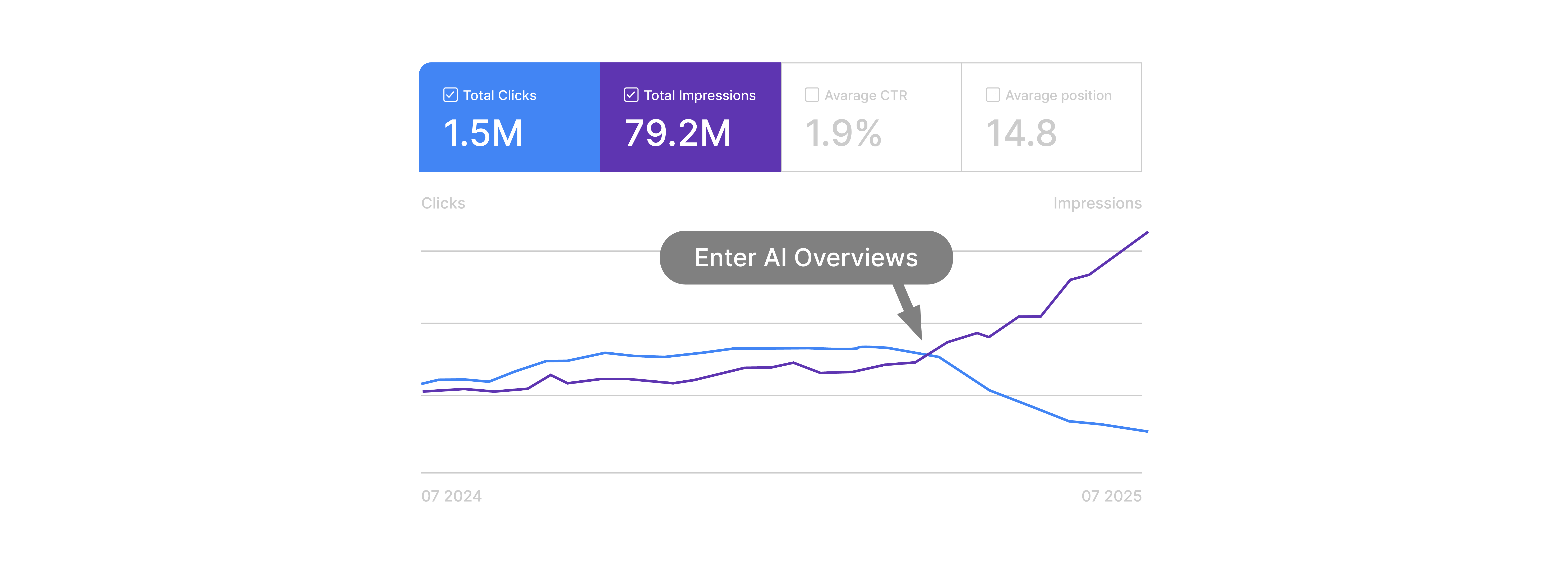
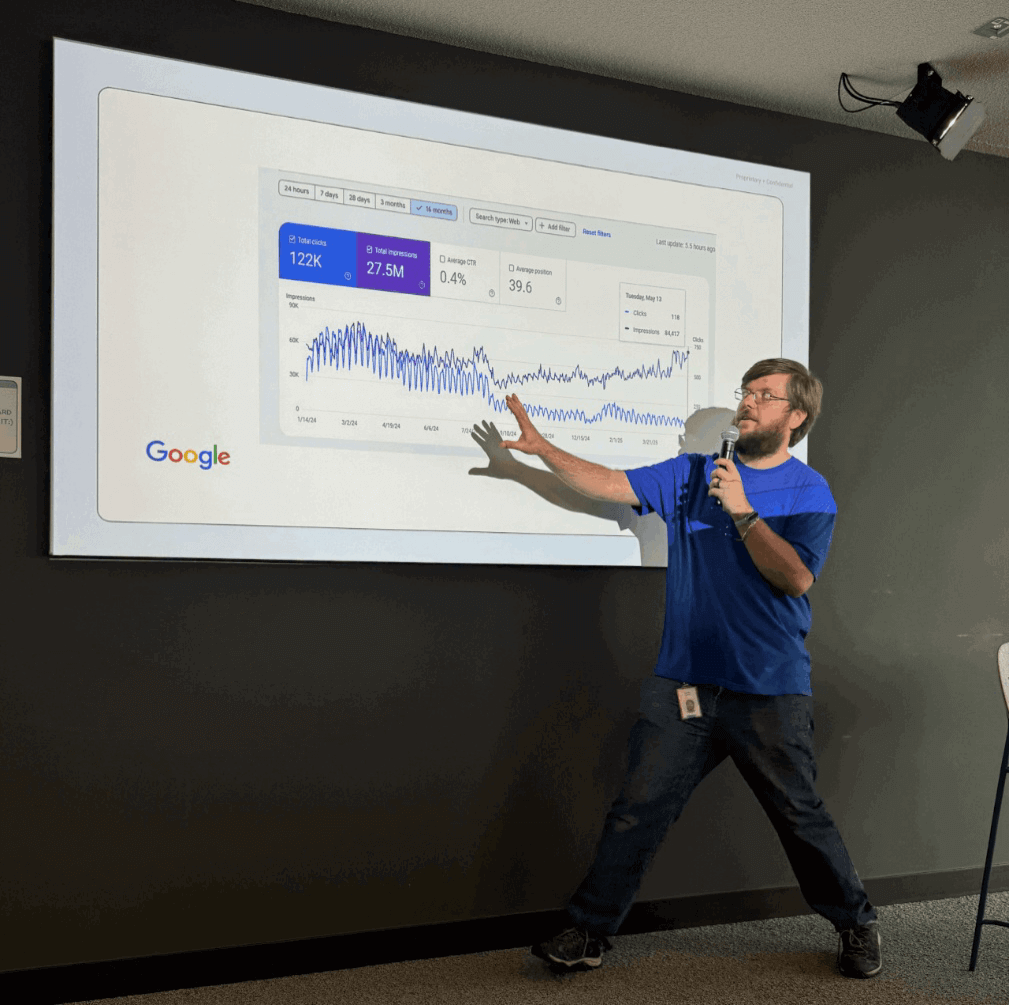
The same trend is visible in Google Search Console data for websites that are heavily affected by AI Overviews. Impressions often remain stable, or even increase, while clicks continue to decline. This growing gap between impressions and actual clicks has become known as the “Crocodile Mouth Effect.”

Photo: Robert Nowaczyk; June 16, 2025; Martin Splitt (Google) explaining The Great Decoupling chart at Google Search Central Live 2025.

The impact becomes even clearer when looking at how people actually search. On mobile devices, for example, users are presented with AI Overviews at the very top of the search engine results page (SERP), offering a concise summary and the most important information. Studies show that around 86% of users simply skim these overviews when searching for factual information. On average, they spend 30 to 45 seconds reading the summary without scrolling further down or clicking on the traditional search results.

When an AI Overview is initially collapsed, 88% of users click “Show more.” Even so, the average scroll depth is only 30%, meaning that most users never reach the traditional organic search results.

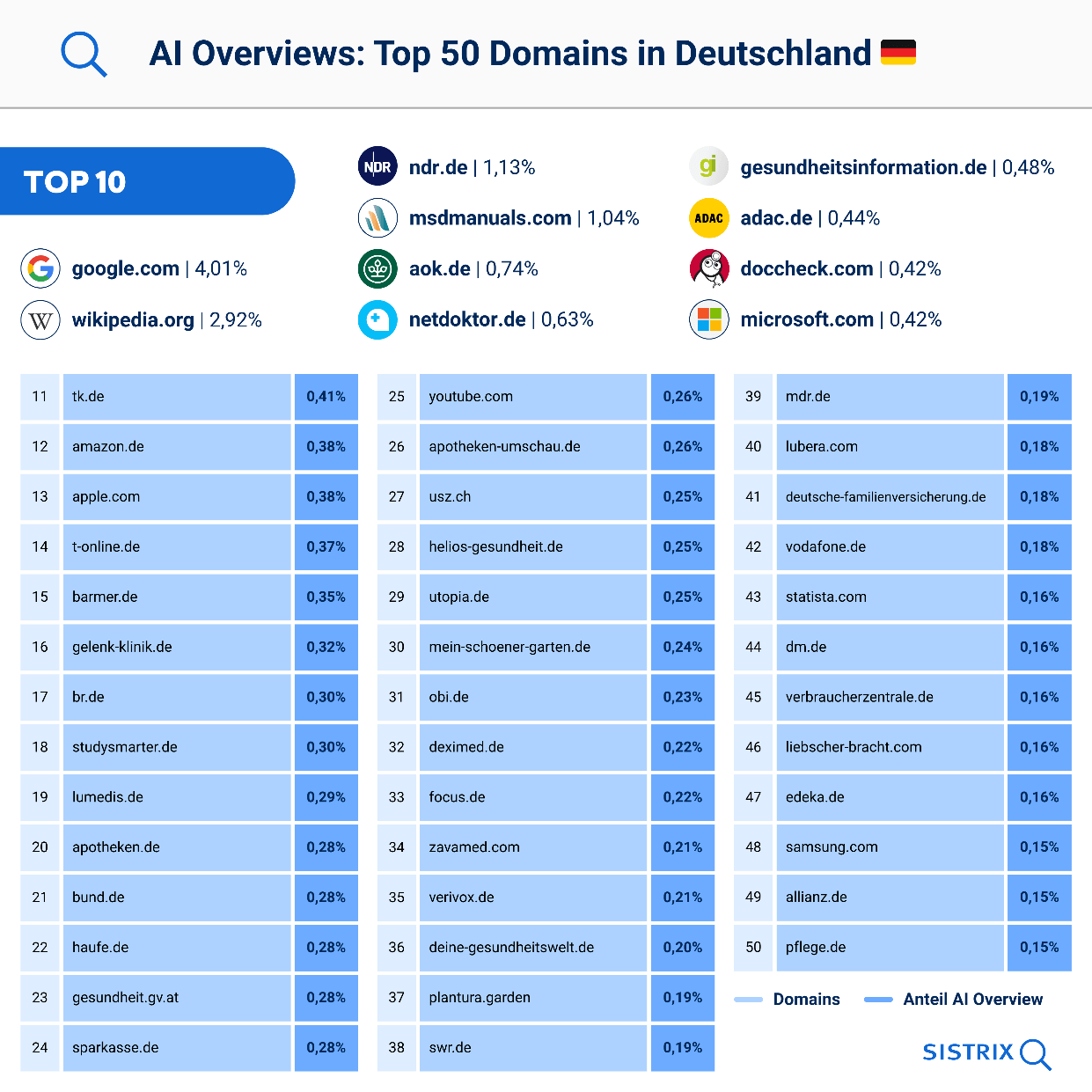
Another interesting observation is that the domains most frequently cited in AI Overviews are not necessarily the same ones that dominate the traditional organic rankings. Health websites such as netdoktor.de appear particularly often, alongside information and news portals such as utopia.de, t-online.de, br.de, and focus.de. While many of these websites also rank well organically, their visibility in AI Overviews follows a different pattern. Because the impact of AI Overviews varies significantly from one domain to another, every website should be evaluated individually. Industry averages can provide general direction, but they are of limited value when assessing the impact on a specific site.

Source: SISTRIX

However, a strong presence in AI Overviews is a double-edged sword. On the one hand, it reflects a high level of trust: these domains are recognized as authoritative and reliable sources of information. On the other hand, it often means that a large portion of their content is summarized directly within the AI Overview. As a result, users have fewer reasons to visit the original website. While visibility remains high, it does not automatically translate into increased traffic.

What Does This Mean for Website Owners?

There is little debate that click-through rates are declining. At the same time, Google reports an increase in both user activity and the number of searches when AI Overviews are displayed. That is undoubtedly good news – for Google. For many website owners who have lost up to 50% of their organic traffic, however, it offers little consolation.

This shift disrupts a long-standing balance. Website owners invest time and resources into creating high-quality content. Google crawls, indexes, and ranks that content in return for sending users to those websites. Even today, most publishers continue to make their content freely available. This benefits AI systems in particular, which use that content for training, accessing up-to-date information, and generating the summaries displayed directly in search results.

But if the clicks disappear, many publishers are left asking a legitimate question: Why continue investing in high-quality content if it no longer generates measurable value in the form of traffic?

This is a challenge that will inevitably need to be addressed. Personally, I doubt the market will regulate itself. A clear legal and regulatory framework may ultimately be required to create a sustainable balance between AI platforms and the publishers whose content they rely on.

The Impact on the Customer Journey

One hypothesis, which has not yet been sufficiently validated by data, is that although overall traffic is declining, the quality of the remaining traffic is significantly higher and converts at a much better rate.

In many cases, users now arrive on websites far better informed than ever before. They already know what they are looking for. Before visiting a website, they may have had extensive conversations with ChatGPT, weighing the pros and cons of different products or services while sharing highly personal context such as their interests, eating habits, training routines, living situation, financial circumstances, health considerations, personal preferences, and much more.

In recent years, large parts of the customer journey have already shifted away from Google and traditional websites. People watch tutorials on YouTube, look for inspiration on TikTok, and read opinions and real-world experiences on Reddit. Large language models (LLMs) are accelerating this trend.

The key takeaway for SEO professionals and website owners is this: If your strategy focuses solely on being visible in Google Search, you are leaving significant opportunities untapped. Organic Google traffic may still be the most important conversion channel, but conversions are far more likely when users have already encountered your brand earlier in their journey – ideally across multiple platforms while researching, comparing options, and seeking inspiration.

The Ultimate Personalization

Personalized search results have been around for many years. They are influenced by factors such as language settings, location, login status, interests, and browsing history. Google’s Local Pack tailors results based on a user’s location, Google Ads uses sophisticated AI algorithms to deliver highly targeted advertisements. Even the balance between informational pages and online stores can vary depending on user preferences. Websites we have recently visited, such as our own, often appear at the top of the search results for us, even if they rank much lower for other users.

By today’s standards, however, this level of personalization seems relatively limited. It was still possible to access largely neutral, non-personalized search results using VPNs, incognito mode, or SEO tools. Tracking those rankings gave us a reasonably accurate picture of what the average user would see for a given search query.

With AI Overviews, ChatGPT Search, and other LLM-powered search experiences, that is no longer the case. People still use keywords or prompts to search for information, but the real question is whether the AI retrieves information based solely on those keywords.

The answer is: yes and no.

This is where the Fan-Out Technique comes into play. Here’s how Google describes it:

“Under the hood, AI Mode uses our query fan-out technique, breaking down your question into subtopics and issuing a multitude of queries simultaneously on your behalf. This enables Search to dive deeper into the web than a traditional search on Google, helping you discover even more of what the web has to offer and find incredible, hyper-relevant content that matches your question.”¹


If I search for “running shoes,” the AI is likely to expand the query based on what it already knows about me. For example:

  • The best running shoes for hard pavement (because I live in a city)
  • The best running shoes for people with knee pain (because I’m in my mid-40s and my knees aren’t what they used to be)
  • The highest-rated running shoes regardless of price (because I’m an agency owner with the latest iPhone – I’m probably willing to spend more)
  • The best running shoes for 10K races at a moderate pace (yes, my phone likely knows that, too)
  • and so on…

Google then selects relevant content from its index for these individual subqueries, extracts the most relevant passages, and combines them into a single AI-generated answer complete with source citations.

To improve future responses, Google also evaluates user interactions such as clicks, scrolling behavior, and follow-up questions. AI Overviews that receive strong user engagement influence which sources and response patterns are prioritized in the future.

The result? My search for “running shoes” may produce a completely different answer than someone else’s.

So how are we supposed to measure a brand’s ranking for a keyword under these conditions? What does a “neutral ranking” even mean if no one receives truly neutral search results anymore?

Will Google ever reveal how the fan-out process works, allowing us to perform at least a simplified version of traditional keyword research?

It may well mark the end of keywords as we have known them.

What Can We Do?

AI is fundamentally changing how people search and how information is presented to them. As a result, a significant portion of our existing skill set -and many of the tools we rely on today could become obsolete in the near future. The strategies and methods we have traditionally used to achieve strong search rankings will also need to be rethought.

There are already several strategic approaches companies can take in response to the rise of AI Overviews. These range from passive acceptance and active collaboration to open resistance or a deliberate shift away from AI Overview–dominated search results by building alternative traffic sources. The most effective long-term strategies for maintaining visibility, brand presence, and control are likely to be either active participation or strategic diversification. Public resistance may increase pressure on Google, but it is unlikely to bring lost traffic back. Passive acceptance is arguably the riskiest approach – yet it will probably be the one most website owners choose.

Because this is an entirely new landscape, there is still very little reliable data on what works and what doesn’t. The situation is remarkably similar to the early days of SEO, when experimentation was the only path to success. And as with every major shift, this one also presents enormous opportunities. SEO professionals and website owners who recognize this opportunity, test different approaches, and continuously adapt their strategies are the ones most likely to benefit.

Here’s an overview of how we’re currently adapting our strategies:

GEO Status Audit

  • Which keywords trigger AI Overviews, and how often is your brand mentioned?
  • Log file analysis: Which content is being crawled by AI bots?
  • Traffic analysis
  • Impact analysis: Which pages or content have been most affected by traffic losses?

AI visibility tracking

  • Define a set of keywords and prompts covering the entire customer journey
  • Set up tracking for relevant AI agents
  • Monitor brand mentions for both your own brand and your competitors
  • Use these insights to develop a clear strategy and actionable recommendations

Custom Gemini Simulation

  • Simulate AI Overviews using a custom Gemini 2.5 setup to better understand content visibility and source selection
  • Analyze how the AI expands queries using the fan-out technique and identify which subtopics trigger citations
  • Use simulation results to systematically increase the likelihood of being cited in AI Overviews

Optimization and Management

  • Content optimization: FAQs, abstracts, clear structure (direct answers, question-based headings, author attribution, clean formatting), and proper source citations
  • Site structure: Internal linking and Schema.org markup
  • Technical optimization: Crawlability and llms.txt

Digital Authority Management and Digital PR

  • Strengthen E-E-A-T signals: social proof and trust elements (e.g., author profiles)
  • Off-page SEO: Mentions, citations, directories and listings, Wikipedia, and PR
  • Social media: Active participation in relevant communities

Alternative Channels Beyond SEO & Google

  • Offline marketing activities
  • TikTok
  • Social media
  • Reddit
  • Owned channels (e.g., newsletters)

Adapt. Optimize. Stay Visible.

In this new AI-driven world, our focus is shifting – from creating content for clicks to creating content that delivers genuine value while building visibility, authority, and relevance across multiple platforms. SEO remains the foundation; it is still our gateway into AI Overviews. But businesses that want to remain visible and competitive in the long term must broaden their strategies. Only then will they be able to maintain a strong presence in an increasingly AI-driven digital ecosystem.