UX Design & Web Design Agency Vienna
Create a design that reflects both your brand identity and resonates with your customers.
A good website is designed to be enjoyable to use and to help users quickly find what they are looking for. As part of the user experience (UX) design process, we analyse the target audience, the content, and the user flow, translating our findings into a clear, well-thought-out structure. Web design then puts these considerations into practice. Our goal is to develop websites that not only look good, but also perform measurably better. That’s why we always consider UX and web design together, supporting projects holistically from analysis and concept to visual implementation.
Some companies we supported with Design:



Case Studies
What is UX Design/Web Design?
UX stands for ‘user experience’ and describes how users perceive and experience a website, application or product when using it. UX design for websites involves analysing and optimising the user experience to enable the most intuitive and simple operation possible. When creating new websites, UX design forms the basis for web design. Aspects such as navigation and reading flow are considered from the outset and planned so that users can navigate the website as purposefully as possible.
The user interface is then designed based on the UX design. UI design is part of UX design and deals with the visual and functional design of the user interface, including layouts, navigation, buttons, typography and interactive elements.
Together, UX and UI ensure that digital products are clearly structured and user-friendly.
The goal
Users enjoy interacting with your website.
What do we focus on in UX Design?
UX design is a holistic approach that impacts all design subareas. To provide a brief overview, we consider the following aspects in our projects:
- Orientation & navigation: Users should be able to quickly understand where they are and how to move on.
- Structure & prioritisation: Content is arranged so that important information is immediately visible.
- Clarity instead of overload: Interfaces are deliberately kept ‘tidy’, and designs without function are avoided.
- Intuitiveness: Users shouldn’t have to think – terms, buttons and processes must be self-explanatory.
- Consistency: Recurring patterns and predictable processes (e.g. buttons, page logic, what happens after a click) make the website feel familiar.
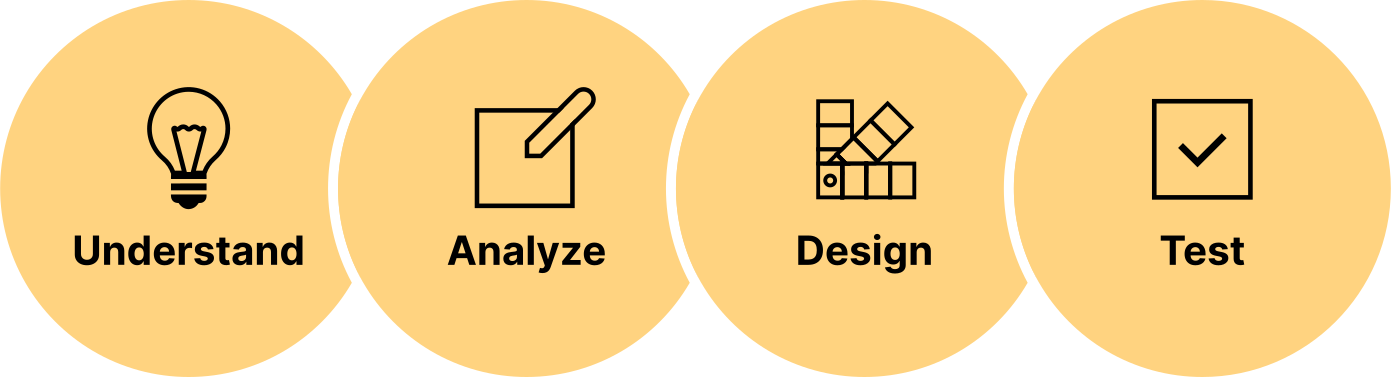
The process: How does the implementation of UX Design work?


When I work with agencies, it’s very important to me that we feel like a team rather than a client and an agency. With .kloos, I feel that they care just as much about our success as we do. Thanks to that trust and the quality of .kloos’s work, we’ve been able to reach a whole new level.
Vanja Lazic, CMO
Store Room
Step 1: Understand
For an existing website, the first step is a careful analysis of its content, user flows and sitemaps. This gives us a clear picture of the website’s current state and of how users currently interact with it. When creating a new website, these factors are incorporated into the initial planning and considered in every subsequent step.
- In a content audit, we review and organise the content, identify gaps and duplications, and prioritise what is really needed.
- When analysing the user flow, we look at the website from the users’ perspective, tracing the paths they take and identifying where they drop off. Navigation should be kept as simple as possible, providing a straightforward route without major detours.
- We analyse who uses the website, define the target audience, and examine users’ goals and whether they are achieved.
The purpose of this first step is to establish a solid foundation for all subsequent decisions.
Step 2: Specify
Based on the analysis, we define the requirements and goals for the subsequent design process. This step determines what the website should and shouldn’t achieve. This includes:
- functional requirements
- content priorities
- prioritisation of user goals
- definition of use cases
Step 3: Design
Now the structure and interface are worked out in detail. Depending on the project, the methods used include:
- Wireframes & scribbles: We create initial sketches and drafts of the website to quickly visualise the structure, content layout and page architecture.
- UI design for individual pages: Specific pages (e.g. the homepage, a service page, a form) and functions (e.g. contact, checkout) are designed.
- Card sorting: Content is grouped logically to create intuitive navigation and page structures.
- Prototypes for early alignment: Clickable prototypes allow you to experience processes at an early stage, enabling us to gather feedback before details are finalised and implemented.
- Accessibility: The Web Content Accessibility Guidelines (WCAG) form the basis for accessible web design and ensure that web content is accessible to everyone. The European Accessibility Act (EAA) makes these requirements mandatory for digital services. From June 2025, websites of certain digital services must therefore be accessible. We incorporate WCAG standards (Level AA) into UX and web design to ensure accessibility is built in from the start.
The goal
Thanks to clear hierarchies, the website is visually appealing and easy to navigate.
Step 4: Test
Before the final page is created, we test concepts and processes using wireframes and click dummies. This allows us to see early on how users navigate, which steps are easy to understand and where uncertainty or unnecessary detours arise. By running through typical scenarios, we can identify weak points in good time and can improve them specifically before the design and implementation are finalised.
Depending on the project, we carry out usability tests in which users perform specific tasks. We also conduct short surveys (e.g. on comprehension, orientation and expectations) and measure success against defined goals.
During the testing phase, designers, developers and clients collaborate closely to take different perspectives into account. One important aspect is the responsiveness of a page: we make sure that structure, operation and processes work flawlessly on different screen sizes and devices.
This lays the foundation for the technical implementation and makes the project ready for development. Depending on your requirements and budget, we build your website using a ready-made theme or create an individual custom web design. Find out more on our development page.
What we offer
We develop unique websites with UX built in from the start. No matter what size your company is, our team will work closely with you to understand your brand values and create a design that resonates with your audience.
For smaller businesses, we offer a compact web design package, providing a website with a clear page structure, UX/UI design, responsive implementation and easy handling in WordPress.
For larger companies, we develop a comprehensive web design package that enables consistent design, clear user guidance and straightforward scalability.

.kloos plays a key role in shaping and strengthening Dinape’s digital presence. From developing our website to optimizing it for search engines and AI-driven discovery, .kloos supports us in making Dinape more visible, accessible, and easier to find across the digital landscape.
Thomas Tittelbach
Dinape
Industries we work with
Potential customers often ask us: ‘Do you already have experience in our industry?’
From our point of view, this is not an important criterion. We see ourselves as a web design and UX design agency, rather than specialists in one particular field.
In recent years, we have gained experience in a wide variety of industries.
We have design expertise in the following areas:
- Webshops, e-commerce, trade
- Doctors, clinics and psychotherapists
- Lawyers
- Tourism, hotels
- Real estate portals, developers, brokers
- Telecommunications
- Financial service providers, banks and insurance companies
- International & multilingual projects
- B2B

Blog
SEO tips in your inbox:
