
What Is On-Page SEO – and Why Is It So Important?


CEO
On-page optimization works on several levels. It ensures that content can be crawled, indexed, and interpreted correctly in the first place. Over that, it plays a major role in the user experience. A clear navigation structure, well-organized content, and fast loading times not only improve the chances of achieving strong rankings but also increase the likelihood that visitors will remain on the website and interact with it.
Unlike off-page optimization, which focuses on external factors such as backlinks, website owners can directly influence on-page optimization themselves. It forms the foundation on which all other SEO measures are built.
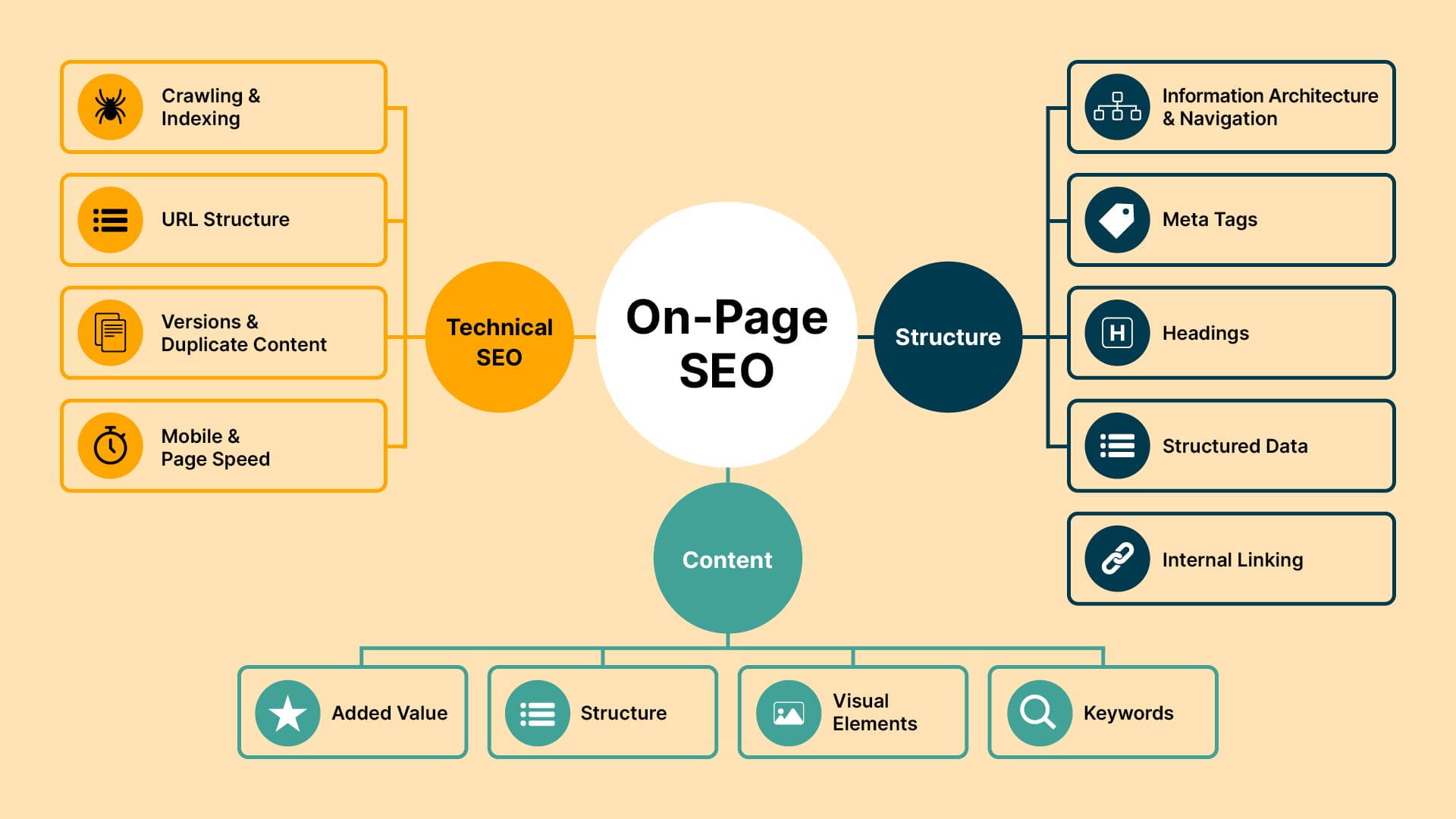
Figure 1: On-page SEO at a glance: technical SEO, structure and content work together.
Technical Optimization: The Foundation for Strong Rankings
Technical optimization ensures that search engines can access a website, crawl its pages, and add relevant content to their index. Even the best content will have no impact if Googlebot cannot reach a page or technical issues prevent it from being indexed.
Crawling & Indexing
The robots.txt file, robots meta tags, and other directives can be used to control which areas of a website search engines are allowed to crawl and index. Incorrect settings can result in important pages being unintentionally excluded.
Search engines discover new pages through links – essentially the road network of the internet. Pages must therefore be accessible via functioning links and connected through internal links.
URL Structure
Clear, descriptive URLs help users and search engines understand what a page is about. Cryptic strings containing unnecessary parameters should therefore be avoided.
✅ /consulting/seo/
❌ /index.php?id=123
Versions & Duplicate Content
One fundamental rule of search engine optimization is that every piece of content should be accessible through a single URL. If several versions of the same page exist, this is referred to as duplicate content. It can confuse search engines and distribute link juice across several URLs instead of concentrating it on a single page.
When several domains are used, such as .at, .de, or .com, all versions must be redirected to one main domain using 301 redirects. During a website relaunch or content migration, old URLs should also be redirected to their appropriate new destinations using 301 redirects. Otherwise, users may land on error pages and existing ranking signals may be lost.
For identical or very similar pages, canonical tags can be used to indicate the preferred original version. This is useful, for example, for products that can be accessed through several categories or URL variations.
Mobile Optimization and Page Speed
A mobile-friendly layout is now one of the technical fundamentals – not least because Google indexes the mobile version of a website before the desktop version. Responsive design ensures that content remains easy to read and use on smartphones, tablets, and desktop devices.
Page speed also affects the user experience. Long loading times increase the risk that visitors will leave the page before they have even seen the content. Tools such as Google PageSpeed Insights and the Core Web Vitals reports in Google Search Console can be used for analysis
Structure: Guidance for Users and Search Engines
In addition to technical optimization, the correct structuring of content is essential. A website’s structure determines how content is arranged, connected, and presented. It helps search engines understand thematic relationships and guides users to the information they are looking for as directly as possible.
Information Architecture & Navigation
Information architecture defines how individual pages are organized hierarchically and grouped into topic areas. Clear navigation allows users and search engines to reach important content with only a few clicks. Larger websites should generally be divided into overview pages, categories, and detail pages. Two extremes should be avoided:
- Important content should not be hidden too deeply within the website.
- At the same time, the main navigation should not be overloaded with every individual subpage.
Meta-Tags
The title tag and meta description are the first elements users see in the search results. They should accurately reflect the page content, spark curiosity, and encourage users to click.
Headings
Headings structure the visible content of a page. In practice, each page should have one clear H1 that describes its main topic. Additional levels such as H2 and H3 divide the text into logically organized sections. Bold body text is not a substitute for a proper HTML heading.
Structured Data
Structured data adds machine-readable information to a page’s content. Schema.org markup can be used to clearly identify products, prices, events, reviews, or companies, for example. Structured data is not a direct ranking factor, but it makes it easier for search engines to extract and interpret content. Structured data is becoming increasingly important again, particularly in the context of Generative Engine Optimization, or GEO.
Internal Linking
Internal linking is an essential element of website architecture. It helps illustrate thematic relationships, increase time on site, and strategically strengthen important pages. Every link should be relevant to the content and use a meaningful anchor text. Pages that are not internally linked are more difficult for search engines to discover and are referred to as orphan pages.
Content That Appeals to Users and Search Engines
Alongside technology and structure, the actual page content is another key element of on-page optimization. Google must be able to identify the topic a page covers and the questions it answers. At the same time, the content must be understandable, useful, and easy for people to read.
Four factors are particularly important:
- Substantial content: High-quality content answers specific questions and addresses the search intent. The intention behind a keyword should already be considered during the content planning stage. Whether a page is intended to inform, advise, or sell influences its structure and tone. Avoid unnecessary filler text and content without substance. Quality is more important than length. Pages containing superficial text that simply strings keywords together no longer achieve sustainable rankings.
- Clear structure: Good readability requires subheadings that divide the text, well-placed paragraphs instead of long blocks of text, and visual emphasis that highlights important information.
- Visual elements: Lists, tables, and information boxes help make information more accessible. Images or embedded videos that meaningfully complement the text break up longer sections and illustrate complex topics. Images should also include alt tags to help search engines understand their content and to support digital accessibility.
- Keywords: Relevant keywords should appear in important places such as the title tag, H1, subheadings, and body text. What matters, however, is not achieving a specific keyword density but distributing search terms naturally throughout the content. Keyword stuffing does not automatically improve a page’s rankings. On the contrary, excessive repetition of search terms reduces readability and can lower the overall quality of the content.
Checklist: Avoid Common On-Page SEO Mistakes
Even well-intentioned optimization efforts can be ineffective when the fundamentals are neglected. The following mistakes occur particularly frequently in practice:
- Important pages are blocked by robots directives
- Identical or missing meta tags
- Missing, unclear, or multiple H1 headings
- Uninformative URLs containing technical parameters
- Duplicate content without canonical tags
- Confusing navigation or pages hidden too deeply within the website
- Missing or broken internal links
- No structured data even though suitable content or data is available
- Poor mobile presentation or long loading times
- Generic content without any clear added value
Website relaunches and content migrations often create errors that could be avoided through regular website audits. Tools such as Screaming Frog and Google Search Console help identify weaknesses at an early stage.
Conclusion
Successful on-page optimization is based on the interaction between technology, structure, and content. Technical optimization makes pages accessible and indexable, structure provides guidance and creates understandable relationships, while high-quality content satisfies the search intent. If any of these areas is neglected, the website will not be able to reach its full ranking potential.